





There is something deeply unsettling about how most artificial intelligence actually works. Behind the headlines and the hype, the reality is surprisingly rigid. A model is trained — which means it looks at millions of examples, finds patterns, and locks those patterns into place. Then it is deployed into the world, where it applies those frozen patterns to everything it encounters, forever, without ever questioning whether the world has changed since it last looked. It is like sending someone into a conversation with a memorized script and no ability to improvise.
This is the gap between what we call artificial intelligence and what intelligence actually is. Real thinking — whether human or animal — is not a fixed script. It is alive. It moves. When you walk into an unfamiliar room, your eyes do not scan every square inch with equal attention. They dart toward what is unexpected, what is out of place, what matters. Your mind is constantly reshaping its own focus based on what it encounters. This is not a feature of intelligence. It is intelligence.
Boris Kriuk, at twenty-one, has organized his entire body of work around closing this gap — building systems that do not merely process information but dynamically reorganize themselves around it. And the results are not theoretical. They are running right now, processing live earthquake data, guiding decisions for public and private sector clients, and generating real revenue.
The idea at the heart of his work is that every model carries inside it an invisible landscape — a kind of internal map where information is arranged according to how the model understands relationships. Most researchers treat this landscape as an accident, a side effect of training. Kriuk treats it as the whole point. His argument, expressed through system after system, is that if you can control the shape of that internal landscape — if you can make it bend and flex in response to what the model is actually seeing — then you get something qualitatively different from a static prediction machine. You get something that adapts.
“A model that cannot understand its own assumptions is not intelligent,” Kriuk has said. “It is a photograph of intelligence. And photographs do not move.”
This matters most in exactly the situations where AI is most needed and most dangerous — when the world does something unprecedented. An earthquake sequence that does not follow historical patterns. A market that breaks every rule traders have relied on. A climate system shifting faster than any simulation predicted. Static models confidently produce answers in these moments, and the answers are wrong, because the patterns they memorized no longer apply. A system whose internal geometry is alive — one that feels when its own assumptions are under stress and shifts accordingly — has a chance of recognizing what it does not know. And that recognition, paradoxically, is the most intelligent thing a system can do.
What makes Kriuk’s position unusual in the industry is not just the idea but the insistence on proving it live. His earthquake monitoring system processes real-time seismic data continuously. His quantitative research systems operate against live markets. His optimization work for European logistics clients has focused on reducing waste and operational overhead. His anomaly detection systems run across sensor networks for municipal clients in Hong Kong. These are not papers describing what might work. They are standing claims, publicly falsifiable, operating against a reality that does not care about benchmarks.
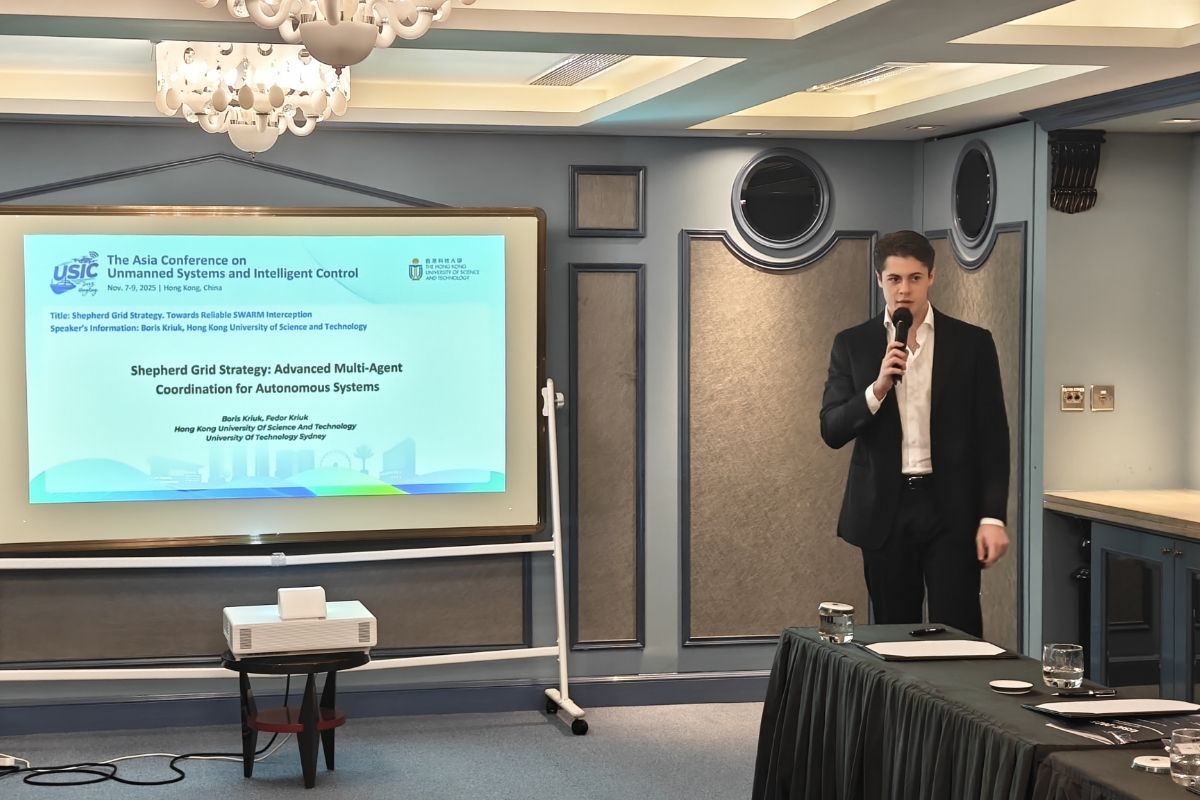
Boris has presented at forums alongside global business leaders and policymakers. He has co-founded companies. He has worked with organizations operating at the highest levels of global commerce. He has done this before turning twenty-two. But the biography is less interesting than the conviction driving it.
“The industry is scaling stillness,” Kriuk has observed. “Building larger and larger systems that hold still more impressively. I am interested in building systems that move.”
This is the philosophical wager at the center of his work — that the future of artificial intelligence is not about making models bigger but about making them alive. Not more knowledge stored in more parameters, but the fluid capacity to reorganize knowledge when the situation demands it. Not a larger photograph, but something that breathes.
The mainstream industry is spending billions on the opposite bet — that scale is everything, that if you make a static system large enough it will approximate dynamism through sheer brute force. Perhaps that bet will pay off. But there is a twenty-one-year-old in Hong Kong whose running systems suggest a different answer, and the world is beginning to notice.